


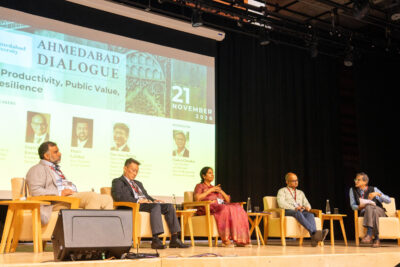
~Ahmedabad Dialogue 2026 brings industry leaders, government officials and global experts together to discuss AI productivity, innovation and responsible adoption in India.
Ahmedabad, Gujarat, Nov 24 (VNI) : Ahmedabad University hosted the third edition of the Ahmedabad Dialogue, bringing together industry leaders, government officials, researchers and global experts to discuss the role of Artificial Intelligence (AI) in productivity, public value and resilience.
The dialogue featured prominent speakers including Punit Lalbhai, Vice Chairman of Arvind Limited, P. Bharathi, Secretary, Science and Technology, Government of Gujarat, Gopichand Katragadda, former Group CTO of Tata Sons, Professor Pao-Ann Hsiung from Taiwan, and Ahmedabad University Vice Chancellor Professor Pankaj Chandra. The discussions emphasised that India must move beyond experimental AI projects and focus on delivering measurable impact.
P. Bharathi highlighted the Gujarat Government’s initiatives to strengthen AI adoption and skill development, including a target of training 500,000 young people in AI during the year, with financial support of up to Rs 50,000 per student. She also outlined plans for a dedicated Taiwan desk to learn from its semiconductor ecosystem and the preparation of a state AI governance policy. Punit Lalbhai stressed that businesses must engage with AI to remain competitive, highlighting the importance of data quality, digital infrastructure and organisational transformation. He said that not engaging with AI presents a significant risk of being left behind.
Professor Pankaj Chandra highlighted the gap between AI’s potential and its actual adoption in Indian manufacturing, particularly among MSMEs. He pointed to inadequate employee training and the lack of digitised processes as major barriers. Gopichand Katragadda urged businesses to move beyond showcase projects and restructure their operations to achieve meaningful productivity gains. Professor Pao-Ann Hsiung shared Taiwan’s experience, emphasising the importance of a strong supply chain, education and government support in building a competitive semiconductor ecosystem.
The dialogue also examined AI applications in healthcare and sustainability. Dr Anunaya Jain of Jhpiego shared how an AI-based predictive model helped achieve a four-fold reduction in treatment interruptions among HIV patients in Nigeria. Dr Arindam Ray of the Gates Foundation highlighted India’s eVIN network, which monitors vaccine stocks and cold-chain temperatures at nearly 30,000 points. Dr Shweta Agarwala of Ahmedabad University discussed the use of AI in discovering skin-compatible electrode materials for textile-based treatment of muscle atrophy in ICU patients. Experts also discussed AI’s energy and water consumption, data bias, accountability and the importance of human oversight.
The central message of the Ahmedabad Dialogue was that meaningful AI adoption requires more than technology investments and pilot projects. Clean data, skilled people, redesigned workflows, responsible governance and collaboration between industry, academia and government are essential to achieving lasting results. Hosted annually by Ahmedabad University, the Ahmedabad Dialogue provides a platform for policymakers, industry leaders, researchers and practitioners from India and across the world to discuss critical issues shaping the country’s development. VNI NEWS, Ahmedabad Dialogue 2026, Artificial Intelligence India, AI Adoption Gujarat, Ahmedabad University, AI Productivity, Ahmedabad University, Ahmedabad Dialogue, Artificial Intelligence, AI Adoption, Punit Lalbhai, P Bharathi, Gopichand Katragadda, Pankaj Chandra, Gujarat Technology, AI Innovation, VNINews, VNINews.com