


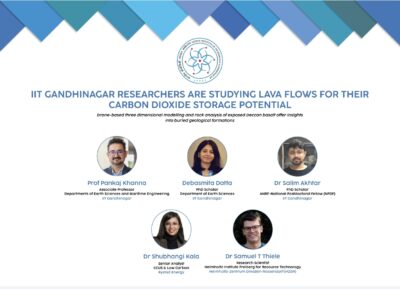
~IIT Gandhinagar researchers study Maharashtra’s Deccan basalt lava flows using drone-based 3D mapping to assess their potential for long-term CO2 storage.
Gandhinagar, Gujarat, Oct 27 (VNI): Researchers at the Indian Institute of Technology Gandhinagar (IITGN) are studying ancient volcanic rocks in Maharashtra to assess their potential for long-term carbon dioxide (CO2) storage as part of global efforts to combat climate change.
According to IITGN, the research focuses on carbon capture and storage (CCS), an emerging approach that involves capturing CO2 emissions and storing them deep underground to prevent their release into the atmosphere.
The study examines basalt rocks belonging to the Deccan Traps, a vast volcanic formation in west-central India created by successive lava flows around 65 million years ago. Basalt is considered promising for CO2 storage because its minerals can react with carbon dioxide dissolved in water and convert it into stable minerals through a process known as mineralisation. However, variations in rock composition, fractures, pores and cavities can influence fluid movement and determine the suitability of individual formations for underground storage.
To investigate these geological characteristics, the researchers studied seven basalt lava flows at Kumbharli Ghat in Maharashtra’s Western Ghats. The study, titled “Characterising the Architecture of Deccan Basalt Flows for Subsurface CO2 Storage: A 3D Digital Outcrop Analogue Approach”, was published in Marine Geoscience and Energy Resources. The research marks the first use of drone-based photogrammetry to map individual lava flows in the Deccan basalt region, enabling scientists to reconstruct three-dimensional models and systematically analyse the boundaries, thickness, shape and internal structure of the rock formations.
Corresponding author Professor Pankaj Khanna, Associate Professor in IITGN’s Department of Earth Sciences and Maritime Engineering, said that understanding the architecture of individual lava flows is essential to identify formations that could support commercial-scale CO2 storage. Lead author Debasmita Datta, a PhD student in the department, noted that the datasets generated through the research could help scientists better understand and model similar basalt formations buried underground, where geological structures are difficult to investigate using conventional methods.
The findings provide a scientific foundation for further assessing the potential of Deccan basalt for long-term carbon storage. The researchers emphasised that each formation must be evaluated individually, considering its mineral composition and fluid-flow characteristics. The study could support future investigations into geological CO2 storage in India and contribute to international efforts to reduce carbon emissions, address climate change and advance the global energy transition. VNI NEWS, IIT Gandhinagar, IITGN researchers, carbon dioxide storage, Deccan basalt, carbon capture and storage, Maharashtra lava flows, IIT Gandhinagar, IITGN, Carbon Capture and Storage, CO2 Storage, Deccan Traps, Basalt Rocks, Kumbharli Ghat, Maharashtra, Climate Change, Drone-Based Photogrammetry, Mineralisation, Geological Carbon Storage, VNINews, VNINews.com