


~Two IIT Gandhinagar-led studies reveal how landslides and dams are altering sediment flow in the Brahmaputra and Godavari rivers, impacting floods, deltas, and river landscapes across India.
Gandhinagar, Gujarat, Aug 07 (VNI): Two studies involving researchers from the Indian Institute of Technology Gandhinagar (IITGN) have revealed how changes in sediment movement are transforming India’s rivers and surrounding landscapes. The research highlights that both natural events such as massive Himalayan landslides and human interventions like dam construction are significantly altering the movement of sediment, affecting floodplains, river islands, and deltas that support millions of people.
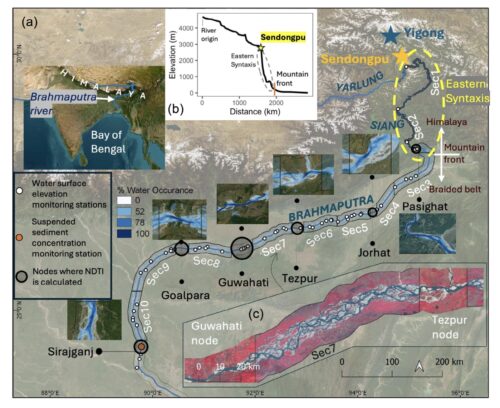
The first study, conducted jointly by IITGN and the University of Leeds (UK) and published in Earth Surface Processes and Landforms, examined the Brahmaputra River. Researchers found that sediments generated by major landslides in the Eastern Himalayan Syntaxis travelled nearly 1,000 kilometres downstream, reaching the river’s delta. The study also observed increased flood extent and a 20–35% rise in sandbar area downstream following the 2017 landslide event, indicating that sediment accumulation can significantly influence flood behaviour.
The second study, published in Anthropocene, focused on the Godavari River. Researchers analysed data from 48 major dams and 23 gauging stations and found that between 1969 and 2013, annual sediment flow in the river declined by around 115 million tonnes, while reservoirs trapped nearly 101 million tonnes each year. The reduced sediment supply has weakened the Godavari delta, leaving it more vulnerable to erosion and rising sea levels.
Dr. Abhishek Dixit, first author of both studies, said the findings demonstrate how both natural disasters and infrastructure development are reshaping sediment pathways across river systems. Professor Vikrant Jain of IITGN noted that while each river behaves differently, understanding sediment movement is essential for improving flood-risk assessments, hydropower planning, and long-term river management in a changing climate.
The researchers said the studies align with India’s priorities under the National Mission for Sustaining the Himalayan Ecosystem, the National Disaster Management Plan, and broader river management initiatives, while also supporting the objectives of the United Nations’ Sendai Framework for Disaster Risk Reduction. VNI NEWS, IIT Gandhinagar, Brahmaputra River, Godavari River, sediment transport, river research, flood risk, dams, delta erosion, River Research, Brahmaputra, Godavari, Earth Sciences, Flood Management, Climate Change, Dams, Delta Conservation, VNINews, VNINews.com