


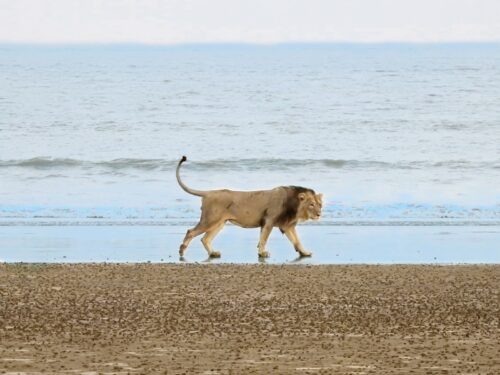
~A new scientific study reveals that Gujarat’s coastal Asiatic lions primarily depend on wild prey rather than livestock, challenging a long-held belief and highlighting the success of the state’s wildlife conservation efforts.
Gandhinagar, Gujarat, July 18 (VNI): A new scientific study has overturned the long-standing belief that Asiatic lions living outside the Gir Protected Area mainly survive on domestic livestock. The research found that lions inhabiting Gujarat’s coastal ecosystem rely predominantly on wild prey, demonstrating the ecological strength of the state’s expanding lion habitat beyond protected forests.
The study, published in the international peer-reviewed journal Conservation, analysed 160 lion scat samples collected during March and April 2024 from the coastal districts of Junagadh, Gir Somnath, Amreli, Bhavnagar and Porbandar. Researchers found that wild prey constituted 64 percent of the lions’ diet and accounted for nearly 70 percent of the biomass consumed, while domestic animals contributed only about 30 percent. Blue bull (nilgai) emerged as the primary prey, contributing 51 percent of the total biomass, followed by wild pigs.
According to Mohan Ram (IFS), Conservator of Forests, Junagadh Circle and one of the study’s authors, the findings contradict the earlier assumption that lions living in human-dominated coastal landscapes depend largely on livestock. Instead, abundant populations of nilgai and wild pigs are enabling lions to sustain themselves naturally, potentially reducing livestock predation and human-lion conflict.
Gujarat, which is home to 891 Asiatic lions as recorded in the 16th Lion Population Estimation-2025, continues to witness the species expanding beyond the Gir forests. The study notes that the southwestern coast, southeastern coast and Bhavnagar coast together now support more than 100 Asiatic lions, reflecting the success of long-term conservation initiatives, including Project Lion, launched by Prime Minister Narendra Modi in 2020.
Forest and Environment Minister Arjun Modhwadia said the study highlights how lions are also benefiting farmers by naturally controlling populations of nilgai and wild pigs, both known to damage crops. Minister of State for Forests and Environment Pravin Mali added that Gujarat’s conservation model, where lions successfully coexist in multi-use landscapes while depending mainly on natural prey, offers valuable lessons for large carnivore conservation programmes worldwide. VNI NEWS, Asiatic Lions, Gujarat Forest Department, Gir Lions, Wildlife Conservation, Project Lion, Nilgai, Wild Pigs, Saurashtra, Conservation Study, Gujarat News, Asiatic Lions Gujarat, Coastal Lions, Wild Prey, Project Lion, Gir Forest, Wildlife Conservation, VNINews, VNINews.com